Agonist and Antagonist Drug Effects on Adrenoreceptors in Relation to Bidirectional Movement in Melanophores of Fresh Water Teleost Fish: Balantiocheilos melanopterus (Bleeker)
Trapti Pathak*, Sonia Johri and J.L. Bhat
Department of Life Sciences, ITM University, Gwalior, India
Published Date: 2025-04-26DOI10.36648/2572-5459.10.2.150
Trapti Pathak*, Sonia Johri and J.L. Bhat
Department of Life Sciences, ITM University, Gwalior, India
- *Corresponding Author:
- Trapti Pathak
- Department of Life Sciences, ITM University, Gwalior, India
- E-mail:trapti.pathak@itmuniversity.ac.in
Received date: July 19, 2024, Manuscript No. IPJARN-24-19424; Editor assigned date: July 23, 2024, PreQC No. IPJARN-24-19424 (PQ); Reviewed date: August 06, 2024, QC No. IPJARN-24-19424; Revised date: April 19, 2025, Manuscript No. IPJARN-24-19424 (R); Published date: April 26, 2025, DOI: 10.36648/2572-5459.10.2.150
Citation: Pathak T, Johri S, Bhat JL (2025) Agonist and Antagonist Drug Effects on Adrenoreceptors in Relation to Bidirectional Movement in Melanophores of Fresh Water Teleost Fish: Balantiocheilos melanopterus (Bleeker). J Anim Res Nutr Vol.10 No.2: 150.
Abstract
In present study, the scales of Balantiocheilos melanopterus (Bleeker) from dorso-lateral trunk represented the sympathetic-neuro melenophore preparations which shown stimulation with agonist drugs i.e., norepinephrine, salbutamol terbutaline, ephedrine etc., and antagonist drugs also known as the microtubule-disrupting drugs i.e., yohumbine, propranolol, phenoxybenzamine, metoprolol etc. It was investigated that adrenergic agonist drugs are strongly induced pigment innervation in melanophores in dose-dependent means while adrenergic antagonist, also known to block effectively the α2-adrenoceptors, act as inhibitors to the action of adrenergic agonists. Their effects were examined in isolated scale of selected fish by Melenophore Index (MI) and it was concluded that the chromatic fibers of melanophores are adrenoreceptors for bidirectional movement due to presence of microtubules and these cells do possess α2-adrenoceptors also.
Keywords
Agonist; Antagonist; Adrenoreceptors; Innervation; Isolated scale; Melanophore
Introduction
The shifting of pigment in the pigment cells, present in the integument, may be induced by various stimuli. However, concerning the rapid change in body shade, known as 'physiological (transitory or chromomotor) color change,' the redistribution of the pigment is typically and effectively regulated by the neural system (autonomic nervous system), the endocrine system (pituitary, hypothalamus and pineal) or commonly both neural and endocrine regulatory mechanisms.
It has been investigated that in many teleost fish species, their chromatophores are primarily controlled by the Autonomic Nervous System (ANS), especially in melanophores and the nerves related to pigment aggregation are sympathetic nerves. In an earlier study, the pathway of melanin aggregating nerves from the melanosome-aggregating center to the melanophores in the minnow species Phoxinus laevis was investigated. This pathway has continued applicable to many teleost fish species with minor modifications. It has been investigated that teleost melanophores are innervated by sympathetic pigmentaggregating fibers only. There are two types of adrenoceptors have been observed and they are designated as α and β adrenoceptors. Since α2-agonist have been found to be more effective than α1-agonist and transmission is more easily blocked by α2 blockers than by α1 blockers. From earlier research studies, it has been observed naturally that adrenergic receptors mediating pigment aggregation in teleost fish melanophores are of alpha nature. On functional basis α- adrenoceptors have been divided into α1 and α2 subtype, it was postulated that the innervation of chromatophores originated from sympathetic post-ganglionic sources, which lead to hypothesis that associated with peripheral neurotransmitter which might be adrenergic, possibly norepinephrine. Actually, in initial it has been also demonstrated that the norepinephrine is released from the nervous elements in response to neural stimuli. It has also been found that predominantly α2 and rarely α1 adrenoceptors are functional in melanophores.
It has been highlighted that understanding the importance of color changes and resulting chromatic states, including color patterns, for fishes without vocal communication abilities is actually a complex task. These adaptations significantly contribute to their self-protection and the overall survival of their species. The true transmitter norepinephrine, acts to induce rapid melanosome aggregation through mediation of α2 adrenoceptors on the melenophore membrane. ATP released concurrently in the absence of norepinephrine is dephosphorylated by ATPase and then by 5-nucleotidase in the synaptic cleft. The resultant nucleoside i.e., adenosine reverses the influence of true transmitter and induces redispersion of pigment through its specific receptors on the membrane of melanophores.
Pharmacological research have already been conducted on the responses of teleost melanophores which has provided evidences suggesting, that the adrenergic peripheral nerve fibers controls melanosome aggregation and involve norepinephrine as the neurotransmitter proposed that the α2 subtype of post-junctional alpha adrenoceptors may play an important role in mediating pigment aggregation in melanophores across various species. Burton and Vokey and Acharya Ovais have further verified the presence of α2 adrenoceptors as the mediators of melanosome aggregation in teleost fishes.
In many freshwater fish species, a wide range of color change which is limited to variations within a black-grey-white spectrum. Depending on the stimuli received, the shade of the body surface can become lighter or darker. Among all chromatophores types present in fish integument i.e., melanophores, xanthophores and irridophores, the melanophores are most prominent and dominant colour cells, which play a vital role in provoking the desired chromatic responses.
Melanophores display a radial arrangement of microtubules originating from the perinuclear space, where the microtubule organizing center is located and extending into cellular extensions. The moving of pigments is regulated via changes in cAMP levels, which successively modify the activity of microtubule motors.
Parker proposed that melanophores in teleosts receive innervation from both pigment-aggregating fibers and pigmentdispersing fibers, suggesting that the former are sympathetic (adrenergic) and the latter are parasympathetic (cholinergic). The teleost fish fauna belongs to the Chambal region basically have the members of family Cyprinidae. There are only 6 genus named Labeo, Catla, Cirrhinus, Garra, Rasbora and Puntius have been studied so far in relation to their pigment cell system and the regulatory mechanisms.
Materials and Methods
Fish used
The fresh water teleost fish B. melanopterus (Bleeker) commonly known as Bala shark, silver shark, tricolor shark or shark minnow was selected for the study and either sexes of selected fish with average weight and length, were utilized for this research work [1].
Care and maintenance
The fishes were treated to fresh aerated water holding KMnO4 to cure them from microbial and other infections They were stocked in a transparent glass aquarium with specific size 30 × 30 × 60 cm for 10 days at temperature 22°C-30°C under natural photoperiodic conditions. The fresh aerated water filled in aquarium tank with the pH range 6.9-7.8 for acclimatization for experiments. Natural photoperiodic condition was maintained with the help of an overhead enlightenment (10 w CFL) fitted 30 cm. above the surface of water of the aquarium was provided. The experimental fishes were fed by commercial diet regularly once in a day (diet given 3% of fishes total weight). The cleaning of glass aquariums were regularly held for elimination of fecal material and uneaten food by drain off method precautiously.
Method used for the preparation of isolated scale slips
From the dorsal sites of the fish skin (Anterior dorsal/Mid dorsal), isolated scale slips are perfectly utilized for this study. These isolated scale slips were, positioned through a fine forceps from the dorsal trunk (anterior to dorsal fin) surface of the selected fish. They were immersed immediately in the physiological saline solution and whenever required replaced by selected agonist or antagonist drugs solution. In order to fix a scale for microscopic investigation [2].
Bidirectional movement in melenophore was observed minutely in a small area of skin born posteriorly by the isolated scale of fish and observations were recorded by light microscope. To change the solution in perfusion chamber it was once drained thoroughly by means of an outlet pipette operated by a suction pump either by Pasteur pipette or by soaking with the help of filter paper and then immediately it filled with drug solution by introducing through an inflow pipette.
To assess the effects of drugs on isolated scale slips, five preparations of a group of 5 adjacent melanophores were made for each individual experiment. Therefore, there were a total of at least 25 melanophores from five scales belonging to 5 different individuals. The observations were recorded according to the Melanophores Index (M.I.) [3].
Preparation and management of doses of selected drugs in study
Preparation of physiological saline solution: Stock solution of all selected drugs were used in present study. An isotonic Physiological Saline Solution (PSS) has been utilized for keeping the melanophores in a dispersion stage that has been prepared with composition as follows (mM): The isotonic K+-rich saline has also utilized in which equimolar concentration of KCl has replaced for NaCl in the physiological saline solution.
Agonist and antagonist drugs used:
• Epinephrine/Adrenaline tartrate ((M.I. Pharmaceutical Works Pvt. Ltd., Kolkata): α- and β- agonist
• Norepinephrine/Noradrenaline bitartrate (Samarth Life Sciences Pvt. Ltd. Mumbai): α- and β- agonist
• Ephedrine hydrochloride (US Pharmacopeia): α and β-agonist
• Salbutamol (Cipla Ltd., Mumbai): Selective β-2 agonist
• Terbutaline Sulphate API (A.B. Enterprises, Mumbai): β-2 agonist
• Yohimbine (Poul Neeuoundrof, Germany): α-2 antagonist
• Propranolol (Ranbaxy laboratories Ltd. India): Non selective β- antagonist
• Metoprolol (Ranbaxy laboratories Ltd. India): β-antagonist
• Phenoxybenzamine (RBI, U.S.A.): Non selective α-antagonist
Stock solutions of the selected drugs for the present study have prepared via dissolving them in PSS or distilled water. For experiment with epinephrine injection diluted with physiological saline solution.
Drugs response on melanophores
Method applied for the assessment of drugs response on melanophores present in isolated scale of fish: There are various methods were used, not only for melanophores but also for other types of chromatophores yet by the researchers. But out of them we have applied an explainer modification of such type of methods, the Melanophores Index (MI). This was initially used by Hogben and Slome for assessment of stages of amphibian melanophores. It includes an uninformed partition of whole range from maximal pigment aggregation to maximal pigment dispersion into five units or stages, the I stage represent maximal range of aggregation, with each one of increasing in number which indicating increasing in dispersion and lastly V stage resembles to the full dispersion state of melanophores (Figure 1) [4].
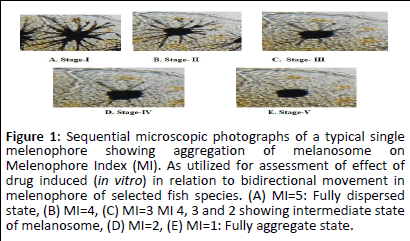
Figure 1: Sequential microscopic photographs of a typical single melenophore showing aggregation of melanosome on Melenophore Index (MI). As utilized for assessment of effect of drug induced (in vitro) in relation to bidirectional movement in melenophore of selected fish species. (A) MI=5: Fully dispersed state, (B) MI=4, (C) MI=3 MI 4, 3 and 2 showing intermediate state of melanosome, (D) MI=2, (E) MI=1: Fully aggregate state.
Ethical statement
The care and use of experimental animals was complied with CPSEA (Committee for the purpose of control and supervision of experimental animals) guidelines as approved by IAEC (Institutional Animal Ethical Committee). Permit reference number: IAEC/ITMU/SOP/2021-01/02.
Results
Effects of agonist drugs on adrenoreceptors
We have used norepinephrine, salbutamol and terbutaline and ephedrine asα and β-adrenergic agonist drugs in the present study for the assessment of their response on adrenoreceptors in relation to bidirectional movement of pigment granules in melanophores of experimental fish (Table 1) [5].
| S. no. | Ingredients/Chemicals | Quantity in 100 ml | |
| 1 | Sodium Chloride (NaCl) | 12.8 | |
| 2 | Potassium Chloride (KCl) | 2.68 | |
| 3 | Calcium chloride | 1.8 | |
| 4 | Glucose | 5.6 | |
| 5 | Sodium hydroxide buffer (Hepes) | 5 | |
| 6 | pH value | 7.4 |
Table 1: Composition of physiological saline solution used in present study.
Effect of norepinephrine
Norepinephrine also known as noradrenaline is secreted from the adrenal medulla of adrenal gland in the blood as a hormone. It is a catecholamine, which plays dual role as a hormone and a neurotransmitter in the central nervous system and sympathetic nervous system and secreted through non-adrenergic neurons from an amino acid-tyrosine and have 10% to 20% of catecholamine hence act as an adrenomimetic drug. The response of norepinephrine has carried out through binding to adrenergic receptors (α1α2 and β1β2) and has high affinity with α1α2and β1 adrenoceptors while low affinity with β2 adrenoceptors.
Melanophores reflects an intermediary stage of colour pigment dispersion on isolation. When perfused in PSS for 15 minutes, they reached fully dispersion at a value of M.I.=5. Then NE was applied on these melanophores with various concentrations ranging from 10-8-10-5M with a concentration of 10-6 M, the NE revealed prompt and faster aggregation of melanosomes, with fully aggregation (M.I.=1) in just10 minutes. Now these NE treated melanophores were perfused in PSS, then a regular and slow dispersion of melanosomes were observed and fully dispersion stage of melenophore at M.I.=5 achieved after a long time period of 60 minutes. That indicating the melanosome aggregation effect with NE was reversible with the removal of the drug. In the current study, norepinephrine at 10-6 M concentration showed faster and quite strong aggregation of colour pigment (melanosome) in PSS equilibrated melanophores (Figure 2) [6].
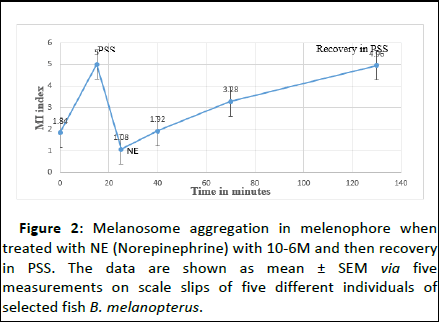
Figure 2: Melanosome aggregation in melenophore when treated with NE (Norepinephrine) with 10-6M and then recovery in PSS. The data are shown as mean ± SEM via five measurements on scale slips of five different individuals of selected fish B. melanopterus.
Effect of ephedrine
Ephedrine is α and β-adrenergic agonist used in the treatment of hypotension, allergic conditions, bronchial asthma and nasal congestion. It is a noncatechol phenylisopropylamine and it is less strong than the norepinephrine.
Melanophores of freshly isolated scale were showing intermediary stage of melanosome dispersion, they were equilibrated in PSS for 15 minutes to achieve fully dispersion stage. Then ephedrine was applied with various concentrations range from 10-8 to 10-5 M on these innervated melanophores, which promotes concentration related aggregation of melanosome in the melanophores. But at high concentration of ephedrine (10-6 M) melanophores were achieved fully aggregation. Aggregated melanophores were then treated with PSS attaining full dispersion after a long time period of 60 minutes, which indicate that the ephedrine agonist act as adrenomimetic drug in the selected fish species (Figure 3) [7].
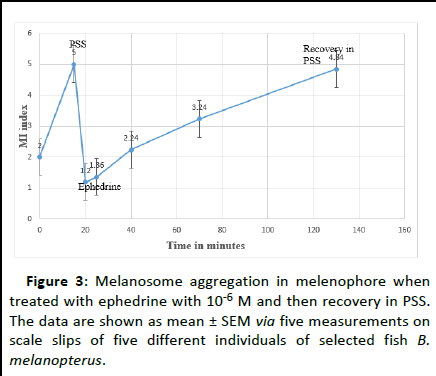
Figure 3: Melanosome aggregation in melenophore when treated with ephedrine with 10-6 M and then recovery in PSS. The data are shown as mean ± SEM via five measurements on scale slips of five different individuals of selected fish B. melanopterus.
Effect of salbutamol
Salbutamol is first selective β2-receptor agonist drug. It is a tertiary butyl derivative which is a pure β-agonist and have great affinity for β2 adrenoceptors than to β1 adrenoceptors.
The freshly isolated melanophores were treated with epinephrine at a concentration of 10-6 M for achieving fully aggregation. These scales now were treated with salbutamol at a concentration of 10-4 M, then melanophores achieved full dispersion within 15 minutes. It has also been recorded during the study, the propranolol totally blocked the effect of salbutamol. If these propranolol treated melanophores were retreated with epinephrine with same concentration (10-6 M), then they achieved fully aggregation again but at a successive treatment of salbutamol again on these melanophores then they not persuade any dispersion not only in salbutamol also in PSS even after a long time period. That indicate the blockade effect of salbutamol through propranolol (Figure 4) [8].
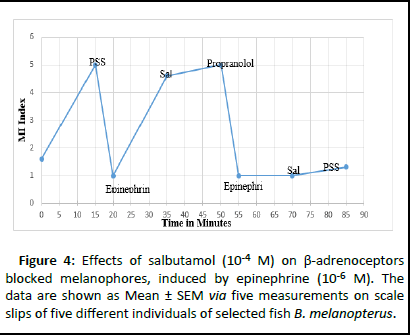
Figure 4: Effects of salbutamol (10-4 M) on β-adrenoceptors blocked melanophores, induced by epinephrine (10-6 M). The data are shown as Mean ± SEM via five measurements on scale slips of five different individuals of selected fish B. melanopterus.
Effect of terbutaline
Terbutaline is a β-agonist drug and utilized as "reliever" an inhaler in controlling asthma symptoms, as a tocolytic agent to delay preterm labor pain, as a rapid-acting bronchodilator.
The freshly isolated melanophores were first equilibrated in PSS for 15 minutes to achieve fully dispersion state and then were treated with epinephrine at a concentration of 10-6 M, they persuade faster and quite strong aggregation of the melanosomes and fully aggregation was achieved in just 5 minutes. When terbutaline with a concentration of 10-4 M, applied on epinephrine treated fully aggregated melanophores, they showed recovery stage within 5 minutes and were fully dispersed at the value of M.I. 5 after 30 minutes (Figure 5) [9].
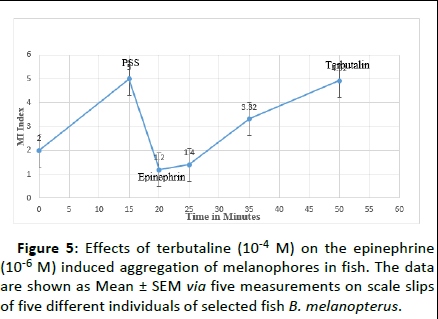
Figure 5: Effects of terbutaline (10-4 M) on the epinephrine (10-6 M) induced aggregation of melanophores in fish. The data are shown as Mean ± SEM via five measurements on scale slips of five different individuals of selected fish B. melanopterus.
Effects of antagonist drugs on adrenoreceptors
Yohumbine, propranolol, phenoxybenzamine and metoprolol were used as α and β-adrenergic antagonist drugs in the present study for the assessment of their response on adrenoreceptors in relation to bidirectional movement of pigment granule melanosomes in melanophores of experimental fish.
Effect of yohimbine
Yohiumbine is a good alkaloid having stimulant and aphrodisiac effects. It is a blocking agent, naturally occurring substance and found in Pausinystalia yohimbe. It is chemically an indole alkyl amine derivative having few similarities in structure with reserpine and lysergic acid and has high quality affinities to α-2 adrenoreceptors. It act as an antagonist to different kinds of receptors except for 5-HT1A. It blocks α2–receptors selectively. Thus it enhances secretion of noradrenaline for a short time duration. It is a significant tool in the observation of presynaptic alpha-receptors.
Their blocking behavior has also been investigated in the selected fish species. On isolation melanophores were in intermediary stage in scale slip. They were equilibrated in the PSS and they showed fully dispersion at M.I.=5 within 15 minutes. Yohimbine was applied on these dispersed melanophores at a concentration of 10-5 M at least for 10 minutes, the melanophores showed continue retain dispersion state at M.I.=5. Then, these melanophores were treated with epinephrine with the concentration of 10-6 M, which reveals inhibition of melanosome aggregation. Then after, these melanophores showed their dispersion stage in PSS even after 50 minutes of post incubation (Figure 6).
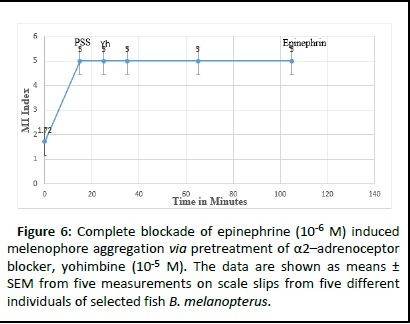
Figure 6: Complete blockade of epinephrine (10-6 M) induced melenophore aggregation via pretreatment of α2–adrenoceptor blocker, yohimbine (10-5 M). The data are shown as means ± SEM from five measurements on scale slips from five different individuals of selected fish B. melanopterus.
Effect of propranolol
Propranolol is a nonselective β-adrenergic antagonist drug belongs to a group of medicines, known as β-blockers. It is utilize in the treatment of heart problems and can stops the action of epinephrine and norepinephrine on both β1 and β2- adrenoreceptors. When propranolol with a concentration of 10-5 M was applied on the fully dispersed melanophores equilibrated in PSS at M.I.=5, they displayed dispersion state again at same value of M.I.=5. After epinephrine application (10-6 M) these melanophores achieved the fully aggregation stage at the value of M.I=1, just in 5 minutes.
Epinephrine was replaced by PSS and the dispersion range showed at M.I.=4.8 within 20 minutes. It is apparent that the drug with particular concentration shows the dispersion of the pigment not only in stable manner but also melanophores required less time for their recovery to the effect of the catecholamine (epinephrine) on the adrenoceptors blockage pretreated scales of experimental fish (Figure 7).
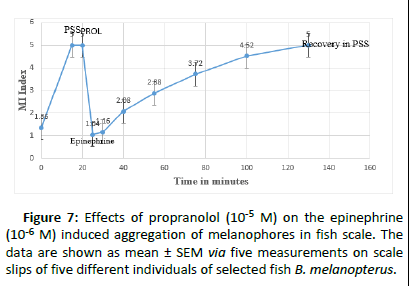
Figure 7: Effects of propranolol (10-5 M) on the epinephrine (10-6 M) induced aggregation of melanophores in fish scale. The data are shown as mean ± SEM via five measurements on scale slips of five different individuals of selected fish B. melanopterus.
Effect of phenoxybenzamine
Phenoxybenzamine act as a non-selective antagonist drug and irreversible alpha receptors blocking agent and blocks both α1- and α2-adrenergic receptors because it produces a stable covalent bond with adrenergic receptors because of the structures of these receptors. It is utilized for the treatment of hypertension and also useful as an anti-hypertensive drug because of its efficiency in decreasing the vasoconstriction that produced through epinephrine and norepinephrine.
The blocking behavior of this selected antagonist drug on the experimental fish, has been investigated by first treatment of phenoxybenzamine was given on the dispersed melanophores at a value of M.I.=5 (which were equilibrated in PSS for 15 minutes), with a concentration of 10-6 M for 15 minutes. With this concentration of drug solution the melanophores continued their dispersion and retained at the M.I.=5. Then after these melanophores were treated out with phenylephrine with concentration of 10-6 M, these melanophores sustained their dispersion even after a long time period of 60 minutes of post incubation. That indicate the blocking behavior of the antagonist on both α1 and α2 adrenoreceptors (Figure 8).
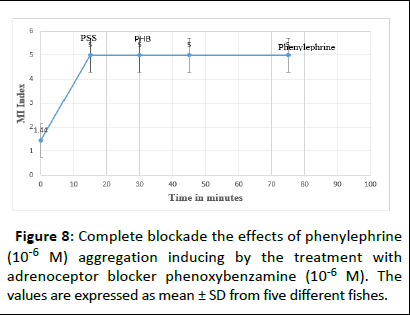
Figure 8: Complete blockade the effects of phenylephrine (10-6 M) aggregation inducing by the treatment with adrenoceptor blocker phenoxybenzamine (10-6 M). The values are expressed as mean ± SD from five different fishes.
Effect of metoprolol
Metoprolol β-blocker and is a β-selective adrenergic antagonist that is lacking of intrinsic sympathomimetic activity. It is utilized in the treatment of hypertension which treats circumstances those cause an arrhythmia.
To assess the effect of metoprolol, on the melanophores of freshly isolated scales, were equilibrated in PSS for 15 minutes, then the scales were treated with epinephrine at a concentration of 10-6 M to persuade their full aggregation followed by treatment with, salbutamol at a concentration of 10-4 M that results in fully dispersion stage of melanophores. That is indicating that metoprolol blocked the effect of salbutamol. Successive treatment with salbutamol fails to persuade any dispersion representing the blockage of the effect of salbutamol by the drug metoprolol (Figure 9).
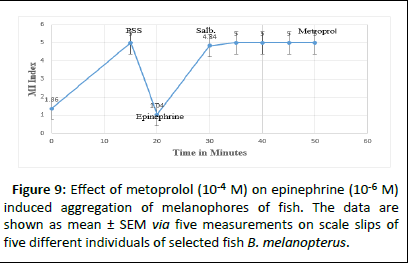
Figure 9: Effect of metoprolol (10-4 M) on epinephrine (10-6 M) induced aggregation of melanophores of fish. The data are shown as mean ± SEM via five measurements on scale slips of five different individuals of selected fish B. melanopterus.
Discussion
Mostly teleost fishes show colour change according to their surrounding backgrounds i.e., became darker in black background while paler in white background. This is because of either neural or endocrinal responses respectively due to stress and other circumstances present in their environment. The shift of the pigments in the pigment cells can be induced by various stimuli, but as far as the rapid change in body shade is concerned with redistribution of the pigments are usually regulated effectively by neural or hormonal system or quite commonly by both of these regulations. For the transport of pigment in the cytosol of melanophores the role of cytoskeletal molecular motors is quite evident. Most teleost fresh water fishes are sensitive to various chemicals, drugs and hormones by means of their melanophores responses present in fish skin. Isolated fish chromatophores have been used as detector for many different substances and several environmental toxins, bacterial pathogens, neurotransmitters and cell membering effecters caused changes in pigment granule distribution by many researchers. These pigmented cells have colour pigment melanosomes, microtubules and have a strong connection with chromatic nerve fibers, which are actually adrenoreceptors or adrenergic in nature. The Melanophore Index (M.I.) method derived by Hogben and Slome was utilized to observe in vitro responses like, studies utilizing the isolated scales of the fish, B. melanopterus to examine the effects of various agonist and antagonist drugs on adrenoreceptors of the melanophores of fish. The melanophore index scale was prepared for the fish previously by aggregating the fully dispersed melanophores with a suitable mediator selecting 3 intermediate stages in between fully dispersed and fully aggregated stages of melanophores (5-1 on MI Index).
To assess the pharmacological and physiological responses of various drugs and hormones in several groups of fishes, researchers conducted in vitro studies using melanophores on isolated scale preparations taken from the dorso-lateral trunk area of fish and found that the melanophores are responsible for controlling the nature of chromatic fibers, adrenergic and neuromelanophore transmission. After investigations of drug effects on fish scale in present study, the results are shown clearly that the melanophores of the selected fish are innervating by sympathetic postganglionic pigment-aggregating chromatic fibers only and have adrenergic nature according to their response shown with various drugs.
Norepinephrine- a strong pigment aggregating hormone in most fish species can induce both aggregation and dispersion depending on the species and receptor type. α receptors dominate in the skin and are responsible for inducing paling in the fish while β receptors are shown to be accountable for excitement darkening or inducing colour patterns with reference to social context used for various communicative behavior in highly social teleost. Results are clearly demonstrating, in the selected fish, the sympathomimetic drugs are catecholamines i.e., norepinephrine which has high affinity with α and β1 adrenoceptors while low affinity with β2 adrenoceptors) and ephedrine etc. Thus, the catecholamines were more effective than other drugs. Study is also suggested that norepinephrine with a concentration of 10-6 M act effectively and has quite strong aggregation of colour pigment which reflects their adrenergic agonist nature because of the aggregation of the melanosomes via centripetal movement in melanophores. The aggregating activity of sympathomimetic amines as well as adrenergic agonists support the existence of sympathetic pigment aggregating fibers of adrenergic character controlling the active rapid aggregation of melanophores in the fish, which is mediated through the α-adrenoceptors. Moreover, in the present study adrenergic and neuromelanophore transmission have also been investigated as respond by the selected drug. During the study, same effects were observed with ephedrine agonist in selected fish species.
With the different α-adrenergic antagonist i.e., yohimbine and phenoxybenzamine, results have cleared in B. melanopterus that yohimbine which is a α2-adrenoceptor antagonist has been investigated as more effective drug which blocked the aggregation response induced by α-adrenoceptor, mainly of α2- subtype. Phenoxybenzamine is α1 adrenergic antagonist agent showed a poor response as compared to complete blockage by α2 antagonist-adrenoceptors on the yohimbine. It was observed that the melanosome aggregation effect of norepinephrine was effectively antagonized, indicating that the uncertainly induced melanophores aggregation primarily depends on the activation of α-2 adrenoreceptors on melanophores. Although a mixed population of both α1 and α2 adrenoceptors cannot be completely ruled out, the dominance of α2 adrenoceptors was evident in selected fish after investigations. Indeed, further exploration of adrenergic drugs can provide insights into the involvement of α1 receptors in inducing melanosome aggregation, which contributes to the observed paling effect in fish. It is worth noting that β-adrenoceptors, which mediate color pigment dispersion, have also been reported in teleost fishes. Also observed paling effect in fishes is indeed attributed to the involvement of α1 receptors in inducing melanosome aggregation. But, it is important to note that β-adrenoceptors, rather than α1 receptors, are responsible for mediating color pigment dispersion in teleost fishes. The β-drugs in this study well capable to persuade quickening of dispersion over control by physiological saline solution which indicates about the role for β- receptors in the selected experimental fish. It was observed that the propranolol and metoprolol, are belongs the group of β-blockers drugs and were capable mediator for significantly decrease the quick dispersion. This action of these β-drugs supports to presence of β- receptors on melanophores in the selected fish species.
Conclusion
The results conclude that with adrenomimetic drugs and adrenolytic drugs are quite evident for aggregating mechanism of melanosomes present in melanophores of the selected fish, B. melanopterus, via post-ganglionic sympathetic pigmentaggregatory chromatic fibers with responses being mediated by α2 adrenoceptors locate on the cell membrane of melanophores of the fish. Also was observed in the present study, that both α1 and α2 adrenoreceptors might be present on the melanophores of B. melanopterus as was reported in Puntius species, Labeo rohita, Clarius sp. Rasbora elanga on the basis of both in vivo and in vitro experiments.
Acknowledgement
The authors are thankful to the Dean, School of Sciences, I.T.M. University, Gwalior, India, who have given good research facility for this work.
Author Contributions
Pathak Trapti, has done this research study on selected fresh water fish species, under the supervision of co-authors Johri Sonia and Bhat J.L.
References
- Acharya LSK, Ovais M (2007) α1 and α2 adrenoceptor mediated melanosome aggregatory responses in vitro in Oreochromis mossambica (Peter) melanophores. Indian J Exp Biol 45:984–991
- Agrawal S (2016) Neural and hormonal regulation of melanophores in fish, Puntius species (Ham.) melanophores. Int J Fish Aquat Stud 4:574–580
- Andersson RG, Karlsson JO, Grundstrom N (1984) Adrenergic nerves and the alpha 2-adrenoceptor system regulating melanosome aggregation within fish melanophores. Acta Physiol Scand 121:173-179
[Crossref] [Google Scholar] [PubMed]
- Amiri MH (2009) Postsynaptic alpha-2 adrenoceptors mediate melanosome aggregation in melanophores of the white-spotted rabbitfish (Siganus canaliculatus). Pak J Biol Sci 12:1–10
[Crossref] [Google Scholar] [PubMed]
- Aspengren S, Wielbass LL, Wallin M (2006) Effects of acrylamide, latrunculin and nocodazole on intracellular transport and cytoskeletal organization in melanophores. Cell Motil Cytoskel 63:423–436
[Crossref] [Google Scholar] [PubMed]
- Baras E, Priyadi A, Legendre M (2007) Ontogeny of the Bala Shark Balantiocheilos melanopterus Bleeker, 1851 (Cyprinidae). Indones Aquac 2:59–66
- Ballowitz E (1893) Die Innervation der chromatophoren. Verh Anat Ges Jena 7:71–76
- Bhargava HN, Jain AK (1981) Circadian oscillation in the rate of paling of the Indian freshwater siluroid, Heteropneustes fossilis (Bloch). Biochem Exp Biol 14:359–373
- Bear MF, Connors BW, Paradiso MA (2007) Chemical control of the brain and behavior. In: Neuroscience, Exploring the Brain, 3rd edn. Philadelphia, Penn: Lippincott Williams & Wilkins, Chapter 15

Open Access Journals
- Aquaculture & Veterinary Science
- Chemistry & Chemical Sciences
- Clinical Sciences
- Engineering
- General Science
- Genetics & Molecular Biology
- Health Care & Nursing
- Immunology & Microbiology
- Materials Science
- Mathematics & Physics
- Medical Sciences
- Neurology & Psychiatry
- Oncology & Cancer Science
- Pharmaceutical Sciences